---
title: The gnoseological problem in modernity
description: The gnoseological problem in modernity. The rationalist
philosophers. Empiristic theses.
author:
name: Graciela Paula Caldeiro
url: http://graciela-caldeiro.idoneos.com
canonical: https://philosophy.idoneos.com/339340/
source: 339340/index.md
---
The gnoseological problem in modernity
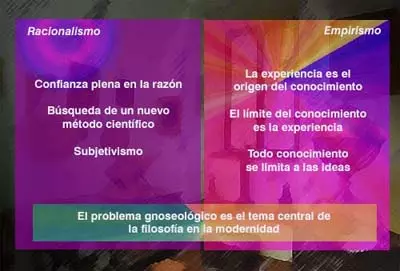 The essential features of racioalism, a philosophical current initiated by **Descartes**, are, first of all, **full confidence in human reason** , which implies accepting that “reason” is the only human lack that can lead man to the knowledge of truth. Confidence in reason is such that its value does not admit criticism, it is therefore, as **Kant** will later assert, a dogmatic reason. **Descartes** will revive the postulate of **Parmenides**: **the same is thought and being. - Yeah .** Secondly, rationalism will be characterized by the **search for an appropriate method of** prosecuting reasoning. And it will be the mathematical method, the chosen system. Finally, the third feature will be **subjectiv**ity. Indeed, while medieval thought was clearly objective and realistic, man does not doubt rality, but in the 17th century, that incipient subjectivism of the **Renaissance**, man becomes upon himself and knows only his own thought. It is possible even to doubt one's own existence. For this reason the gnoseological problem is the central problem of modern philosophy.
The rationalist philosophers
Despite the common points, the differences between the various exponents of rationalism are remarkable. **Descartes** is basically a classic philosopher, while his ideal is order and measure, clarity and distinction. With his work he intends to prurify and renew the science of his time, but at the same time creates a schism between man and the world and a ruputra, moreover, within each man. **Spinoza**, meanwhile, is a representative of the **baroque** and his work introduces movement into the world, aspiration to infinity reducing it, simultaneously, to unity. Finally, **Leibniz**, is characterized by eclecticism and approaches the spirit of enlightenment: it breaks the Cartesian **dualism** and seeks to save the multiplicity of **monism** of **Spinoza** by introducing the idea of harmony.
Empiristic theses
Empirism will hold that **the origin of knowledge is experience** so the mind is like a shallow table. This implies denying the innate ideas that the rationalists accepted. However, Leibniz will observe that Locke's empiricism is not absolute as long as it leaves some door open to innatism. These consequences to rationalism that can be found in Locke disappear completely already in Hume.
Secondly, **human knowledge will not be unlimited as experience marks its limit**. Unlike rationalism, empiricism will deny any possibility of going beyond experience, which is clearly seen in Hume's skepticism about metaphysical problems.
**All knowledge is knowledge of ideas**. It is noted in this thesis, coincidence between both schools, since the mind can know ideas, but not things and thinking is reduced to linking ideas with each other. In the case of Berkeley, this postulate will lead him to idealism, denying the reality of the perceptible world.